
Walk out to your front yard thirty minutes after a torrential spring downpour, and you will likely witness the quiet devastation that haunts every landscape professional: your freshly blown double-shredded hardwood mulch is no longer neatly hugging your hydrangeas. Instead, it has washed across the walkway, choked out the sod, and formed soggy logjams against the concrete curb. It is a frustrating, messy, and expensive rite of passage for homeowners and property managers alike.
For years, I stood over washouts like this with a heavy steel rake, cursing the topography, cursing the heavy clay subsoil, and occasionally cursing the weather forecasters. But over two decades of studying soil physics, monitoring watershed dynamics, and testing hundreds of installations across varying slopes, my perspective shifted entirely. Mulch runoff is rarely just bad luck; it is a mechanical failure. It happens when rainfall energy overcomes surface friction, when particle interlocking fails, and when subgrade hydrology is entirely ignored.
The industry has long treated mulch as a purely aesthetic topping—a colorful cosmetic layer meant to make beds pop for real estate listings. Yet, empirical research tells an entirely different story. Global meta-analyses and watershed studies confirm that a properly engineered mulch layer acts as a critical armor for the earth, absorbing the kinetic energy of falling raindrops, slowing surface flow velocity, and vastly improving infiltration rates. When we respect mulch as a hydrological tool rather than mere ground cover, the physics of runoff management finally begin to work in our favor.
The Physics of Raindrop Impact and Surface Dislodgement
To understand how to keep mulch in place, you must first understand what actually moves it. Raindrops do not fall lazily from the sky; during severe storms, they strike bare earth or poorly secured mulch beds at terminal velocities reaching up to thirty feet per second. This explosive impact shatters soil aggregates, detaches organic particles, and initiates splash erosion. Once those particles are suspended, sheet flow takes over, carrying organic matter down any available gradient.
Standard double-shredded bark behaves differently under this bombardment than coarse wood chips or shredded forest products. Finer particles float easily, meaning a heavy downpour can quickly lift lightweight fines and transport them to lower elevations. Meanwhile, heavy chunks roll downhill if the underlying slope exceeds critical thresholds. Research into water erosion control indicates that mulch coverage rates, particle size distributions, and slope gradients dictate more than ninety percent of sediment loss. If you apply mulch to a slope steeper than thirty percent without mechanical stabilization, gravity and hydraulics will inevitably win.
Furthermore, hydrophobic conditions play a silent, destructive role in mulch movement. When organic mulch dries out completely during a summer drought, it develops a water-repellent waxy coating. When the next heavy rain arrives, the water beads up and slides right off the top of the mulch layer instead of infiltrating. This creates a miniature flash flood right inside your planting bed. The mulch floats on this sheet of rejected water, riding the current down your slope like a fleet of tiny wooden rafts. Breaking this cycle requires understanding how moisture retention and surface tension interact within the organic matrix.
Selecting the Right Material Matrix for Slopes and Flat Terrain
Not all mulches are created equal, and choosing the right material for a specific micro-climate is the single most important decision you will make. Smooth, uniform nuggets look tidy in a nursery display, but they are aerodynamic disasters on a slope. Round cedar nuggets act like ball bearings; the slightest trickle of water sends them rolling out of the beds and across the lawn. They lack the jagged edges and fibrous interlocking capabilities required to anchor themselves against gravity and flowing water.
Instead, professional installations on sloped terrain rely on fibrous, interlocking materials such as shredded hardwood bark, "gorilla hair" cypress, or heavy-duty chipped forest waste. These materials feature long, stringy fibers that weave together like a dense textile mat. When saturated, these fibers swell slightly and knit into a cohesive blanket that resists displacement. Recent field trials evaluating organic mulch thickness and type show that a uniform application of three to four inches provides optimal energy dissipation without suffocating the root zone. Go thinner than two inches, and bare patches form rapidly; go thicker than four inches, and you risk creating an anaerobic barrier that repels water and rots plant collars.
Another powerful modern alternative is the inclusion of composted bark fines or stabilized organic blends that bind tightly with the underlying soil profile. When fine organic matter mingles with the top layer of native soil, it creates a transitional zone. This biological and mechanical bridge anchors the upper decorative layer securely, preventing the wholesale sliding that plagues homeowners who rely purely on loose, unaged wood chips.
Engineering the Subgrade and Establishing Drainage Fundamentals
The most common mistake in landscape maintenance is treating mulch as a superficial band-aid for poor grading and drainage. If water is concentrating from a downspout, a patio runoff, or an adjacent turf slope and funneling directly through your planting bed, no amount of expensive mulch will stay put. Effective runoff prevention begins beneath the surface, long before the first shovel of mulch is unloaded from the tail of a truck.
Before laying down organic material, evaluate the hydrology of the bed during a moderate rain event. Observe where water pools, where it accelerates, and where it breaches containment edges. If necessary, shape the subgrade to create micro-swales or terraced contours that break up long, uninterrupted slopes. Water traveling down a ten-foot continuous slope gains exponentially more kinetic energy than water interrupted by two five-foot steps or shallow earthen berms.
Edge definition also plays a massive structural role. Shallow, sloppy spade-trenched edges often collapse under the weight of saturated mulch and heavy runoff. A deep, clean-cut V-trench—at least four to six inches deep with a vertical inside wall—acts as a physical trench trap. It catches migrating mulch before it spills onto turf or paving, while allowing clear water to drain away safely. For extreme slopes, integrating subsurface French drains, catch basins, or dry creek beds redirects destructive hydraulic pressure away from the vulnerable mulch zones entirely.
Advanced Mechanical Stabilization and Retention Techniques
When gravity refuses to cooperate, purely organic solutions must be reinforced with physical stabilization techniques. Steep hillsides, commercial embankments, and areas prone to severe storm surges require structural interventions to lock the mulch matrix into place. One highly effective method involves the use of biodegradable or permanent erosion control blankets, such as jute netting or coir mesh, pinned directly to the soil slope with heavy sod staples before the mulch is applied.
The mulch is then broadcast directly over and into the open weave of the mesh. The netting acts as a permanent structural skeleton, holding every individual wood fragment firmly against the earth even when subjected to heavy runoff velocities. Over two or three seasons, biodegradable coir mesh slowly breaks down, by which time plant root systems have established a dense, natural anchoring network that permanently secures the slope.
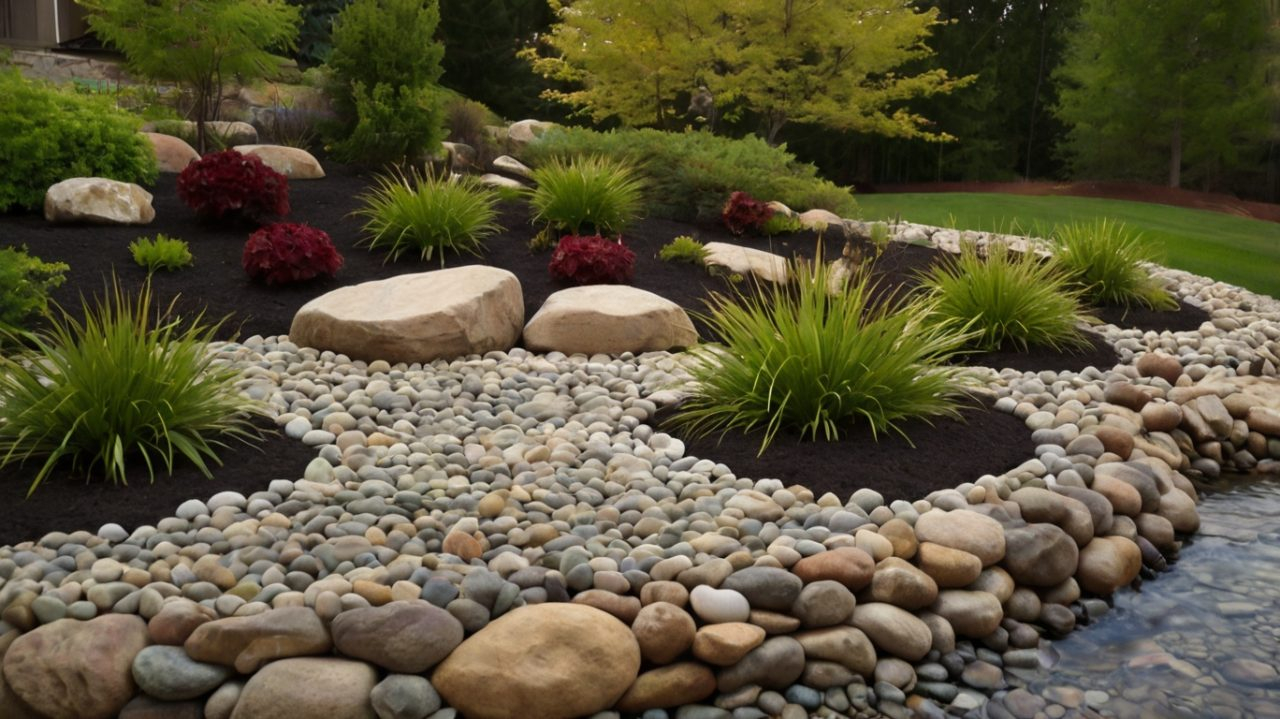
Another reliable field technique is the strategic placement of anchor stones, boulders, and living groundcovers. Arranging medium-to-large boulders along the contour lines of a slope breaks the fetch of the water, dividing a destructive sheet flow into manageable, low-energy rivulets. Interplanting with aggressive, deep-rooting native perennials, ornamental grasses, or creeping shrubs transforms the aesthetic entirely while providing biological reinforcement. Roots act as subterranean rebar, binding soil particles and locking the entire ecosystem in place against the forces of erosion.
Step-by-Step Implementation Protocol for Runoff-Proof Beds
To translate these principles into an actionable workflow for your next landscaping project, follow this field-tested, step-by-step installation methodology:
- Site Assessment and Hydrological Mapping: Walk the property during or immediately after a rainstorm to identify runoff channels, high-velocity flow paths, and areas prone to pooling or washouts.
- Subgrade Grading and Trenching: Shape the underlying soil to eliminate direct channels. Cut deep, clean V-trenches (minimum 4-6 inches) along hardscape and turf borders to act as physical retention traps.
- Erosion Control Matting Installation (For Slopes Over 25%): Roll out heavy-duty jute or coir netting on steep embankments, securing it firmly to the earth with steel sod staples spaced every two to three feet.
- Material Selection and Depth Calibration: Choose a fibrous, interlocking organic mulch (such as double-shredded hardwood or chipped forest product) and apply a strict, uniform layer measuring 3 to 4 inches deep.
- Post-Installation Compaction and Watering: Lightly tamp or settle the fresh mulch with a gentle water shower from a hose, activating the natural interlocking of the fibers without washing them away.
Navigating Common Pitfalls and Practitioner Workarounds
Even experienced landscapers occasionally stumble when dealing with stubborn washouts. Recognizing these recurring mistakes and applying proven workarounds saves time, money, and endless frustration:
- Pitfall 1 (Applying Mulch Too Thickly): Piling mulch five to six inches deep creates a hydrophobic crust that sheds water entirely and suffocates plant roots. Workaround: Strictly maintain a 3-to-4-inch maximum depth and fluff compacted areas annually with a grading rake rather than dumping fresh layers on top.
- Pitfall 2 (Using Decorative Rounded Stones or Nuggets on Slopes): Selecting smooth cedar nuggets or river rock for inclined beds guarantees gravitational failure. Workaround: Reserve rounded materials exclusively for flat, contained courtyards; use fibrous, stringy shredded barks on any slope exceeding a 10-percent grade.
- Pitfall 3 (Ignoring Gutter and Roof Runoff): Allowing unmanaged downspouts to discharge directly onto mulch beds will blow out even the best installations. Workaround: Extend downspouts underground using solid PVC pipe to discharge safely into rain gardens, dry wells, or storm drains away from decorative beds.
- Pitfall 4 (Neglecting Edge Containment): Relying on shallow surface edges lets water slide right over the boundary, carrying mulch onto turf and walkways. Workaround: Cut deep, vertical-walled spade edges or install rigid steel, aluminum, or stone edging anchored securely with stakes.
- Pitfall 5 (Blowing Mulch Too Close to Plant Crowns): Piling mulch volcano-style against tree trunks and shrub stems traps moisture against the bark, inviting rot and pests while encouraging washouts. Workaround: Maintain a 2-to-3-inch clearance around all plant stems, tapering the mulch down to a thin, neat ring at the outer edge.
The Broader Ecological and Economic Value of Stable Landscapes
Preventing mulch runoff is about far more than keeping your property looking sharp for weekend guests. When mulch stays where you put it, you protect your financial investment. Replacing washed-out mulch every single spring is an unnecessary recurring expense that drains household budgets and wastes valuable resources. Furthermore, keeping organic matter on your beds protects the soil microbiome. That mulch layer serves as an insulating blanket, moderating soil temperatures, suppressing invasive weed seeds, and slowly breaking down into nutrient-rich humus that feeds your plantings.
From an environmental standpoint, stable mulch beds prevent nutrient loading in local municipal stormwater systems. When heavy rains wash loose mulch and topsoil into street gutters, those organic particles carry nitrogen, phosphorus, and sediment directly into local storm drains, eventually choking nearby creeks, ponds, and rivers with algae blooms and silt. By engineering your landscape beds to retain every drop of water and every ounce of mulch, you transform your yard into an active watershed sponge that filters, cleans, and infiltrates stormwater naturally.
As extreme weather events become increasingly frequent and intense due to shifting climate patterns, landscape resilience is no longer optional. Designing beds that can withstand a two-inch-per-hour cloudburst without losing a single wheelbarrow of mulch requires foresight, respect for natural physics, and sound installation practices. When you stop fighting nature and start working with the mechanics of water flow, friction, and biology, your landscape transforms from a high-maintenance headache into a self-sustaining, resilient ecosystem.
The next time you hear heavy rain lashing against your bedroom window in the middle of the night, you do not need to wake up with a knot of anxiety wondering what your front yard will look like at dawn. If you have engineered your beds with the right fibrous materials, shaped your subgrades with proper drainage in mind, and established deep, clean retention edges, that storm becomes nothing more than a free, deep-watering session for your plants.
Landscape maintenance is ultimately a continuous dialogue between human intention and natural systems. Over the years, the most profound lesson I have learned is that nature rarely responds well to brute force. When we try to bully water and gravity with superficial fixes, we always lose the argument. But when we observe how water moves, respect the physics of soil and organic matter, and build our landscapes with structural integrity from the ground up, we achieve something far better than temporary perfection. We build landscapes that endure.