
You’ve seen the pictures. That serene, koi-filled oasis tucked behind the hydrangeas. It looks peaceful. It looks expensive. But does it have to break the bank? In 2026, with material prices still fluctuating and labor costs through the roof, more homeowners are grabbing shovels instead of calling contractors. It feels empowering. It also feels risky.
I didn’t just guess at the numbers. I kept every receipt. Every bag of gravel. Every foot of tubing. From the first sketch on a napkin to the final splash of water, I tracked it all. This isn’t a theoretical budget from a glossy magazine. This is the raw, messy, real-world cost of building a pond yourself this year. And honestly? It’s not what you think.
The Hidden Price of Planning and Permits
Before you dig a single hole, you need to know where you can dig. In many suburbs, zoning laws have tightened up since 2024. I learned this the hard way. I assumed my backyard was a free-for-all. It wasn’t. I had to pull permits for electrical work and structural excavation. The permit fees alone ran me about $150. Not huge, but annoying if you aren’t expecting it.
Then there’s the design phase. You might think you can wing it. Don’t. I spent $45 on specialized pond-design software because drawing on graph paper wasn’t cutting it for the pump calculations. I also bought three books on local aquatic ecosystems. That’s $60 right there. Some people skip this. They regret it when their pump burns out in week two. Knowledge isn’t free, but it’s cheaper than replacing equipment.
Don’t forget utility checks. Calling 811 (or your local equivalent) is free, but marking the lines took time. If you hit a gas line, the cost is infinite. So, factor in a weekend of waiting and planning. It feels like wasted time, but it’s insurance. The total pre-dig cost? Around $255. Small change compared to what’s coming, but it sets the tone. Budgeting starts before the dirt flies.
Excavation and Structural Basics
Digging is the most physical part. It’s also where hidden costs lurk. I rented a mini-excavator for two days. In 2026, rental rates have jumped. I paid $320 per day, plus a $100 delivery fee. That’s $740 just to move dirt. You could use a shovel. Please don’t. Your back will hate you, and it’ll take three weeks. Time is money, remember?
Once the hole was dug, I needed to stabilize the edges. The soil in my yard is sandy. It collapses like a sandcastle. I had to buy geotextile fabric and retaining wall blocks for the upper tier. The fabric was $85. The blocks were $210. I also needed underlayment for the liner. Cheap underlayment rips. I went mid-range. $120 for a heavy-duty roll.
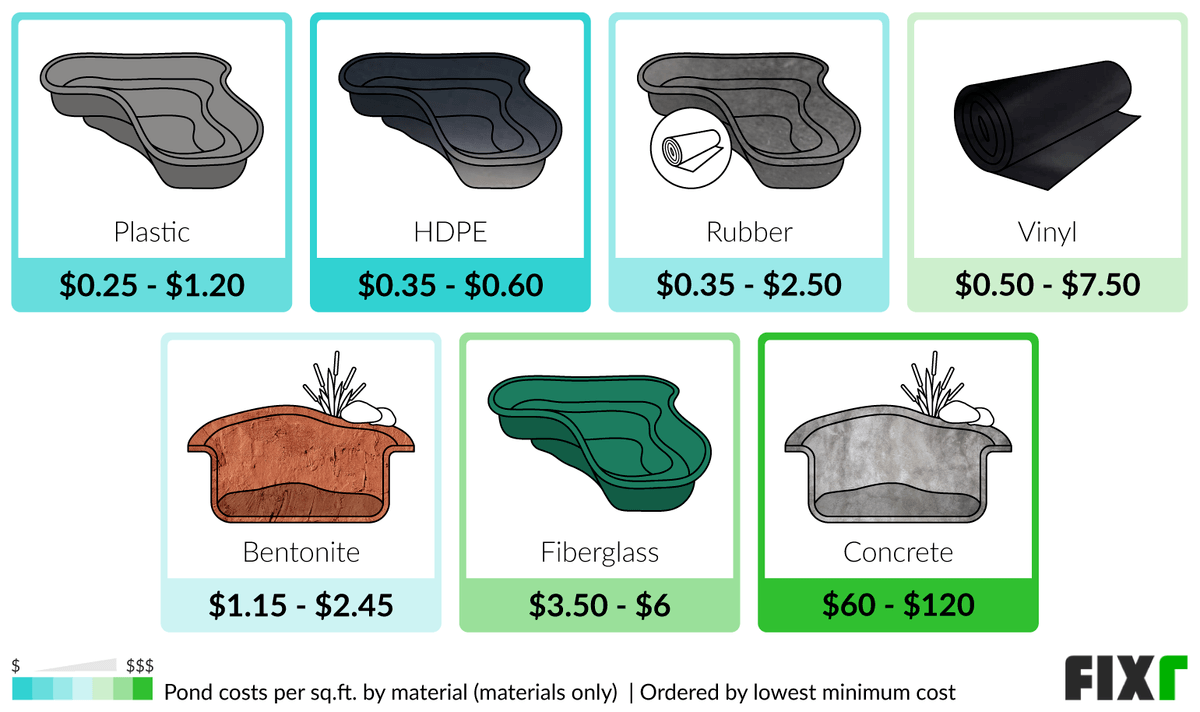
Then, the liner itself. This is the heart of the pond. I chose a 45-mil EPDM rubber liner. It’s durable and fish-safe. For a 10×15 foot pond, it cost $380. I also bought a separate piece for the waterfall spillway. $90. People try to save money here by using tarps or cheap plastic. Don’t. A leak means draining the whole thing and starting over. That’s a cost you can’t afford. Total for structure and excavation materials? Roughly $1,625. Ouch.
Plumbing, Filtration, and Electrical Work
Water needs to move. Stagnant water is a mosquito breeding ground. It smells. It looks bad. So, plumbing is non-negotiable. I used flexible PVC piping. It’s easier to work with than rigid pipe. I spent $140 on pipes, fittings, and sealant. I also needed a skimmer box and a biological filter. These aren’t optional if you want clear water. The skimmer was $110. The bio-filter was $195.
The pump is the engine. I went with a variable-speed DC pump. They are more efficient and quieter. In 2026, energy efficiency matters more than ever. The pump cost $280. It moves 2,500 gallons per hour. Overkill? Maybe. But I’d rather have too much power than too little. You can always dial it back.
Electrical work was tricky. I’m handy, but I’m not an electrician. I ran conduit from the house to the pond site. That’s 40 feet of trenching. I hired a pro to hook up the GFCI outlet and connect the pump. Safety first. That electrician bill was $450. I saved money doing the trenching myself, but the hookup was worth the peace of mind. Total for this section? $1,225. It adds up fast when you’re dealing with water and electricity.
Rocks, Gravel, and Aesthetic Details
Now comes the fun part. Making it look natural. This is also where budgets explode. You need rocks to hold the liner in place and to create shelves for plants. I drove to three different quarries. Prices vary wildly. I ended up buying 1.5 tons of river rock. That cost $320, including delivery. I also bought smaller gravel for the bottom. $85.
Plants are essential. They filter the water naturally. I bought water lilies, hornwort, and iris. Local nurseries are pricey. I found a wholesale grower online. Saved 30%. Still, I spent $175 on plants. You can’t skimp here. Bare ponds look artificial. They also struggle with algae. Plants compete with algae for nutrients. It’s basic biology.
Lighting makes the pond magical at night. I installed low-voltage LED lights around the perimeter and underwater. The kit cost $130. I wired them into the same transformer as the pump. It looks professional. It feels luxurious. But it’s just plastic and wire. Don’t let the marketing fool you. You’re paying for the look. Total for aesthetics? $710. It’s the cherry on top, but cherries are expensive.
The Surprise Costs Nobody Talks About
Here’s the stuff that doesn’t make it into the tutorials. Debris removal. I had extra dirt. Lots of it. Hauling it away cost $180. I couldn’t just pile it in the corner. The HOA would have fined me. Then, tools. I broke two shovels. I bought a new wheelbarrow. $60. I needed gloves, knee pads, and eye protection. $45. These are small items, but they add up.
Water fill-up. It takes a lot of water to fill a 1,500-gallon pond. My water bill spiked by $40 that month. Not huge, but noticeable. Also, dechlorinator. You can’t just dump tap water in with fish. It kills them. I bought a large bottle of conditioner. $25.
Then, the inevitable mistake. I mismeasured the liner overlap. I had to buy a patch kit and extra adhesive. $35. And lunch. You get hungry digging holes. I spent about $50 on food and drinks during the build weekends. It’s silly to ignore it. If you’re tracking actual receipts, you track the sandwiches too. Total surprise costs? $435. It’s the "oops" fund. Always have one.
The build is done. Now what? Maintenance is the ongoing cost. Filters need cleaning. Pumps need checking. I bought a net, a vacuum, and test strips. $70 upfront. Monthly, I spend about $15 on replacement filter media and water treatments. That’s $180 a year. Electricity for the pump runs about $20 a month in summer, less in winter. Say $200 a year for power.
Fish food. If you add koi or goldfish, they eat. A lot. High-quality food is expensive. $100 a year minimum. Vet bills? If a fish gets sick, it’s tough. Most vets don’t treat fish. You learn to medicate them yourself. Another $50 for meds.
Winterizing is big. In colder climates, you need to protect the pump and liner. I bought a floating de-icer and insulation covers. $90. If you skip this, your pump cracks. Then you’re back to square one. So, the first year of ownership costs about $700 in maintenance and utilities. It’s not free. It’s a living system. It demands attention. And cash.
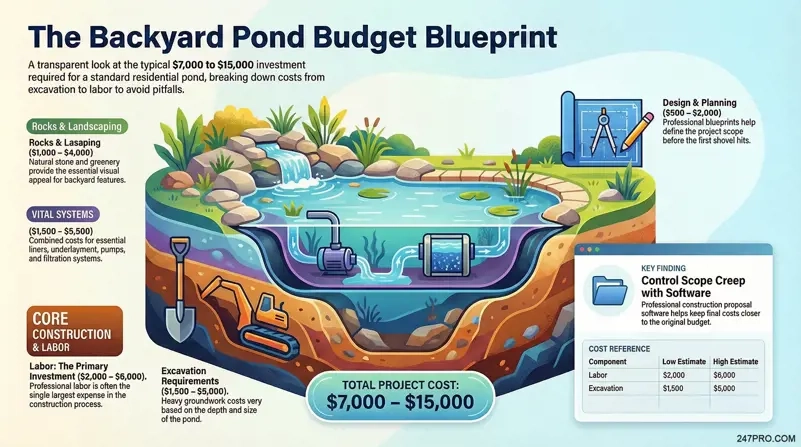
Building a pond is rewarding. It’s beautiful. It brings nature to your doorstep. But it’s not cheap. The total build cost came to $5,000 exactly. Plus $700 for the first year of upkeep. Could you do it for less? Sure. If you scavenge rocks. If you dig by hand. If you skip the lights. But then it’s not the same project. It’s a different pond. Know what you’re signing up for. Measure twice. Dig once. And keep every receipt. You’ll need them.