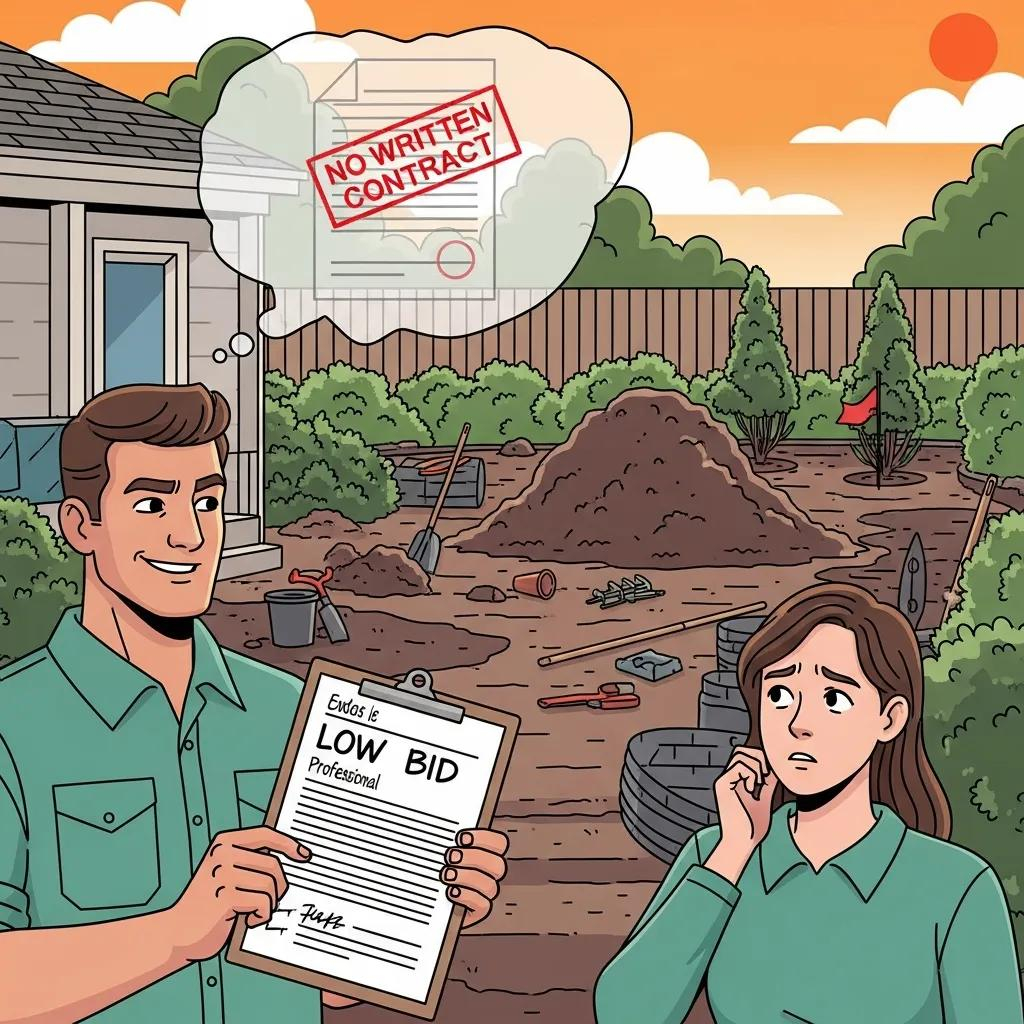

The damp scent of thawing mulch hangs heavy in the air, mixed with the universal suburban anxiety of the spring upgrade season. It is the time of year when driveways blossom with neon-orange contractor signs and mailboxes fill with glossy flyers promising paradise by next Tuesday. For Sarah and Mark, who spent three winters staring at a mud pit that used to be a backyard, the breaking point arrived during the first warm Saturday of April. They flagged down a passing crew, shook hands on a verbal promise, and waited for the magic to begin. Two weeks later, the crew vanished, leaving behind a mountain of crushed limestone, half-buried irrigation lines, and an escalating text thread demanding an extra four thousand dollars for "unforeseen ground conditions."
This scene plays out across neighborhoods with disheartening regularity. The modern residential landscaping market has transformed into a high-stakes arena where supply chain volatility meets a massive labor squeeze. Contractors juggle material price spikes for natural stone, concrete pavers, and specialized nursery stock, pushing operational costs upward. Unfortunately, this volatility also attracts predatory operators and disorganized handymen who hide their lack of competence behind opaque pricing models. When an estimate arrives as a single, rounded lump sum on a crumpled piece of paper or a poorly formatted email, it is rarely an expression of simplicity. More often, it serves as a carefully constructed smoke screen designed to mask structural flaws, regulatory shortcuts, and financial vulnerability.
Navigating this terrain requires shifting away from passive consumerism and adopting the analytical eye of an investigative auditor. A landscaping quote is not merely a bill for services rendered; it is a legally binding contract, a project management blueprint, and a reflection of a business’s operational integrity. Every line item, payment schedule, and material specification tells a story about how a project will unfold over the coming weeks. Learning to read between the lines protects not only your checking account, but your sanity, your weekends, and the long-term structural health of your property.
Anatomy of an Estimate and the Dangers of Lump-Sum Ambiguity
The single most pervasive hazard in residential contracting is the grand total lump-sum quote. When an estimate simply lists a project description like "Complete Backyard Transformation" followed by a bolded figure of $24,500, the contractor is effectively transferring all financial and operational risk directly onto the homeowner. Without itemization, there is no structural baseline to measure progress against, nor is there any way to evaluate whether the pricing aligns with current market rates for labor and materials. Professional landscaping requires a delicate choreography of excavation, drainage engineering, hardscape installation, and horticultural science, each carrying distinct cost structures and margin profiles.
When these elements are compressed into a single number, margin inflation thrives. Unscrupulous operators use the lump-sum format to pad estimates with hidden contingency cushions while simultaneously cutting corners on invisible foundational work. For instance, a patio installation might look stunning on day one, but if the aggregate base was compacted at three inches instead of the industry-standard six inches, the entire structure will heave and settle within two freeze-thaw cycles. An itemized quote forces the contractor to specify the exact depth of the sub-base, the specific brand and grade of pavers, and the linear footage of edge restraint. This transparency establishes accountability from the outset.
Furthermore, a lack of itemization strips the homeowner of their decision-making agency. During any major outdoor renovation, field conditions inevitably shift—utilities are found running where blueprints said they shouldn’t, or soil composition requires unexpected stabilization. If the initial quote is nothing more than a bottom-line figure, any adjustment becomes an arbitrary argument over subjective value. With an itemized estimate, change orders can be evaluated objectively against baseline unit costs, preventing inflated pricing during the heat of construction. Demanding granular detail is not a sign of distrust; it is the baseline requirement of responsible property stewardship.
The Mirage of Lowball Pricing and Material Substitution Traps
In any competitive bidding environment, human psychology leans heavily toward the lowest financial figure. When three contractors quote $15,000, $18,500, and $24,000 for the exact same conceptual design, the temptation to label the highest bidders as greedy gougers is immense. However, in professional landscaping, a radically lower quote is almost always an indicator of compromised quality, hidden exclusions, or financial distress within the contractor’s business model. Material costs are largely public knowledge; wholesale nurseries, stone yards, and aggregate suppliers charge consistent baseline rates to licensed operators. Therefore, a steep discount cannot come from purchasing smarter—it must come from cutting corners.
The most common victim of lowball pricing is material quality. A quote might specify "natural flagstone patio" without noting the stone’s geological classification, thickness, or country of origin. A low-tier operator will substitute high-grade, dense Pennsylvania bluestone with thin, brittle Indian sandstone that is prone to salt spalling and thermal cracking under harsh winters. Similarly, in softscaping bids, quotes often hide inferior plant stock sourced from clearance yards—root-bound shrubs, diseased trees, or annuals that have outgrown their nursery pots and will suffer transplant shock. If a quote lacks botanical Latin names, container sizes, and explicit cultivar specifications, assume the lowest-cost materials will be used to protect the contractor’s profit margin.
Beyond materials, lowball quotes frequently omit the labor-intensive, unglamorous aspects of landscape construction. Excavation hauling fees, soil disposal permits, geo-textile stabilization fabrics, and proper sub-grade compaction are routinely left off low-cost estimates to make the bottom line look attractive. Once work begins, these omitted necessities are reintroduced as mandatory extras, transforming the "cheap" bid into the most expensive option on the table. Recognizing that professional craftsmanship, skilled labor, and commercial-grade materials command a fair market rate is the primary defense against the trap of the bargain-basement estimate.
Decoding the Paperwork: A Step-by-Step Guide to Auditing a Landscaping Proposal
Reviewing a complex landscaping proposal requires a systematic, investigative approach. You must move through the document with a critical eye, ensuring every phase of the project is accounted for and legally protected.
- Step 1 (Verify Licensing and Insurance Verification): Check the contractor’s license number against state or local databases, and insist on calling their insurance carrier directly to obtain a certificate of liability and workers’ compensation naming you as the certificate holder. Never accept verbal assurances or expired paper certificates.
- Step 2 (Scrutinize Material Specifications): Examine every plant, stone, and fixture mentioned in the text. Ensure specific botanical names, caliper sizes for trees, gallon ratings for shrubs, paver manufacturers, and aggregate depths are explicitly written out rather than described with vague adjectives like "high quality" or "standard."
- Step 3 (Analyze the Payment Schedule): Reject any proposal demanding more than 10 to 30 percent as a down payment before materials arrive on site. Tie subsequent progress payments to verifiable milestones, such as completed excavation, installed sub-base, or finished planting, retaining at least 10 percent until final walk-through inspection.
- Step 4 (Inspect Site Prep and Disposal Clauses): Confirm who is legally and financially responsible for utility locates (calling 811), soil disposal, root pruning, site grading, and post-construction cleanup. Ensure the quote states whether heavy machinery damage to turf, irrigation lines, or neighboring driveways will be repaired at the contractor’s expense.
- Step 5 (Review Warranty and Maintenance Terms): Look for explicit, written guarantees on hardscape structural integrity (typically one to five years) and plant survival rates (usually through one full growing season, provided watering guidelines are met). Clarify what voids the warranty and who handles warranty claims.
Navigating Change Orders, Timelines, and Legal Loopholes
Even with the most meticulously crafted quote, outdoor construction is inherently unpredictable. Mother Nature uncovers buried ledge rock, subsurface water tables, and abandoned utility infrastructure that no blueprint could anticipate. This is where the mechanics of the change order become a critical battleground. A professional quote must include an explicit clause outlining how unforeseen site conditions will be handled, including hourly labor rates, equipment rental markups, and material cost percentages. If a contract is silent on change orders, or worse, grants the contractor unilateral authority to perform extra work and bill for it later, you are standing on dangerous legal ground.
Equally treacherous are timelines detached from accountability. Phrases like "Work to begin in spring, weather permitting" give a contractor infinite license to drag out a project over months while jumping between multiple job sites. A robust quote includes a projected start date, an estimated duration of active construction, and a realistic completion window. While weather events like torrential spring rains or prolonged freezes are legitimate interruptions, a professional operation maintains a structured schedule and communicates delays transparently. If a contract lacks timeframes, the project can easily become a low-priority afterthought parked in your backyard.
Finally, examine the dispute resolution and lien waiver clauses hidden in the fine print. Unscrupulous operators sometimes omit mechanic’s lien warnings or fail to provide unconditional lien waivers upon receiving progress payments. This oversight can leave a homeowner vulnerable to secondary lawsuits from unpaid subcontractors or material suppliers who delivered stone and timber to your property but never received their money from the primary contractor. Ensuring that your contract requires signed lien waivers with every payment protects your property title from unexpected encumbrances and enforces professional accountability at every tier of the operation.
The Ripple Effects of Bad Quotes on Property Value and Ecosystem Health
Accepting a flawed, ambiguous landscaping quote carries consequences that extend far beyond a frustrating renovation season. Outdoor construction fundamentally alters a property’s hydrology, soil biology, and structural engineering. When cheap contractors cut corners on site drainage—failing to pitch hardscapes away from the foundation or neglecting to install proper French drains and catch basins—the results manifest as basement water intrusion, foundation settlement, and accelerated soil erosion. A poorly executed landscape can easily wipe out thousands of dollars in real estate equity, turning an intended asset into an expensive structural liability.
On an environmental level, amateur landscaping practices disrupt local microclimates and watershed health. Inexperienced crews frequently strip topsoil entirely, compacting sub-soils with heavy machinery until they resemble concrete. This destroys soil microbiome networks, choking root systems and requiring massive inputs of synthetic fertilizers and chemical pesticides to keep struggling plants alive. Furthermore, improper grading can channel runoff straight into neighboring properties or municipal storm drains, carrying sediment and chemical treatments into local waterways. Professional landscape design accounts for native ecology, permeable paving options, and sustainable soil management that enhances, rather than degrades, the surrounding environment.
The economic ripple effect also hits the local labor ecosystem. Contractors who operate on razor-thin margins by using vague quotes often underpay field labor, skip workers’ compensation insurance, and cycle through revolving-door crews with zero oversight. This creates a race to the bottom where ethical, highly skilled landscape architects and master craftsmen struggle to compete against operators who cut legal and ethical corners. By refusing to sign predatory or vague quotes, homeowners actively support a healthier, more transparent local trade economy that rewards genuine craftsmanship and business integrity.
Blueprint for Accountability: Essential Safeguards Before You Sign
Transforming the quoting process from a guessing game into a reliable business transaction requires a proactive, structured framework. Before pen touches paper or a deposit is wired, you must establish clear boundaries and demand complete operational transparency. The goal is to establish a collaborative partnership where both parties understand their obligations, risks, and financial boundaries.
- Demand Detailed Site Plans: Never approve a quote based solely on a verbal conversation or a rough hand-drawn sketch on a notepad. Insist on scaled, dimensional drawings that map out utility locations, plant species placement, drainage paths, and material boundaries.
- Establish a Clear Communication Protocol: Require the contractor to designate a primary project manager who will provide weekly written updates, progress photographs, and a direct line for immediate concerns. Avoid companies where you must chase down multiple subcontractors for answers.
- Verify Subcontractor Transparency: If the primary contractor plans to sub out specialized tasks—such as low-voltage architectural lighting, retaining wall engineering, or major tree removal—demand that their licenses, insurance, and contact information be explicitly listed in the contract.
- Incorporate Holdback Provisions: Structure final payment to be contingent upon a comprehensive joint inspection. Ensure any minor touch-ups, regrading adjustments, or plant replacements are documented on a punch list and completed before the final dollar changes hands.
- Consult Independent Experts: For high-value projects exceeding tens of thousands of dollars, consider hiring an independent landscape architect or structural engineer to review the technical specifications of the quote before committing your capital.
The process of shaping the land around a home is a profound act of stewardship. When executed correctly, a professional landscaping project breathes new life into a property, creating outdoor living spaces that nurture family life, support local ecosystems, and anchor long-term financial equity. Yet, achieving this vision requires stepping past the polished marketing pitches and examining the hard, unvarnished mechanics of the estimate. By rejecting lump-sum ambiguity, lowball material traps, and unaccountable timelines, homeowners reclaim control over their investments.
As the industry continues to evolve amidst economic shifts and material demands, the line between professional artistry and predatory contracting grows sharper. Armed with a critical eye, itemized analysis, and a commitment to contractual transparency, you can navigate this season’s renovation market with absolute confidence. Take your time, ask the difficult questions, and remember that a truly professional contractor welcomes scrutiny as an opportunity to demonstrate their craftsmanship and integrity. Your backyard sanctuary is worth protecting from the foundation up.